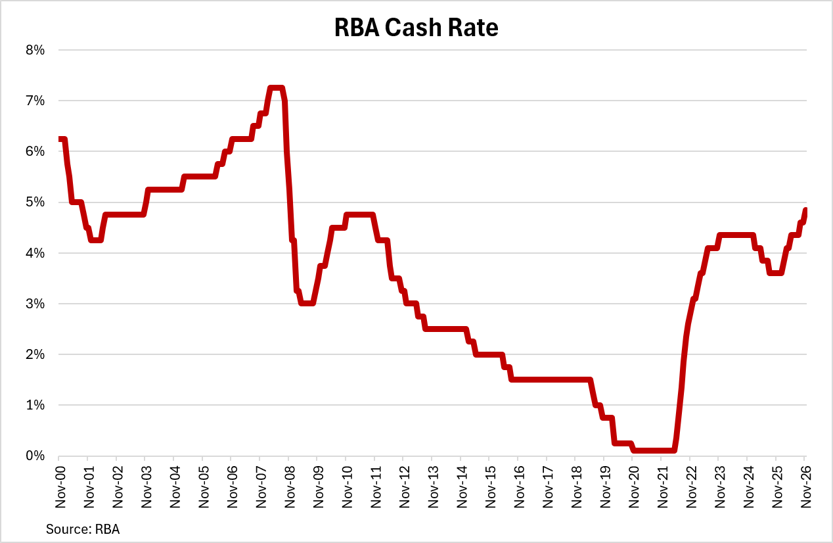
The RBA has increased interest rates for the fifth time this year, taking the cash rate to 4.85%.
The decision comes at a time when Australia’s property market was already slowing. Fewer homes are selling, prices have moved lower and buyers are taking more time to make decisions.
But interest rates aren’t the only thing influencing the market. Cost of living pressures, changes to investor tax rules and uncertainty about the global economy are also affecting how people feel about their next move.
Five rate rises are starting to add up
The RBA has increased the cash rate by a total of 1.25 percentage points this year, from 3.60% to 4.85%. It’s now at its highest level since 2008.
The cash rate isn’t the rate you pay on your home loan. But when it rises, lenders often increase their mortgage rates too. For many households, that means more of the monthly budget goes towards repayments.
For example, if a lender passes on the full 0.25 percentage point increase, it would add around $125 a month in interest to a $600,000 interest-only loan. The change in repayments will depend on the loan, the lender and how much time is left to pay it off.
People on fixed rates may not feel the change immediately, but will need to consider the rates available when their fixed term ends.
Why did the RBA increase rates again?
Inflation is still above the RBA’s target. The latest ABS figures showed consumer prices increased 4.3% over the year to September. Underlying inflation, which looks past some of the more volatile price movements, was 3.6%.
The RBA is concerned that inflation is taking longer to come down. Higher fuel and energy costs are part of the story, but the Bank also pointed to price and cost pressures across other parts of the economy.
At the same time, the RBA acknowledged that the economy is slowing, unemployment has risen and housing prices have fallen. The decision wasn’t unanimous. Six board members voted to increase rates and three voted to hold.
My concern is that another rate rise puts more pressure on mortgage holders and people trying to borrow, while doing less to directly address some of the supply and cost pressures contributing to inflation.
The property market was already slowing
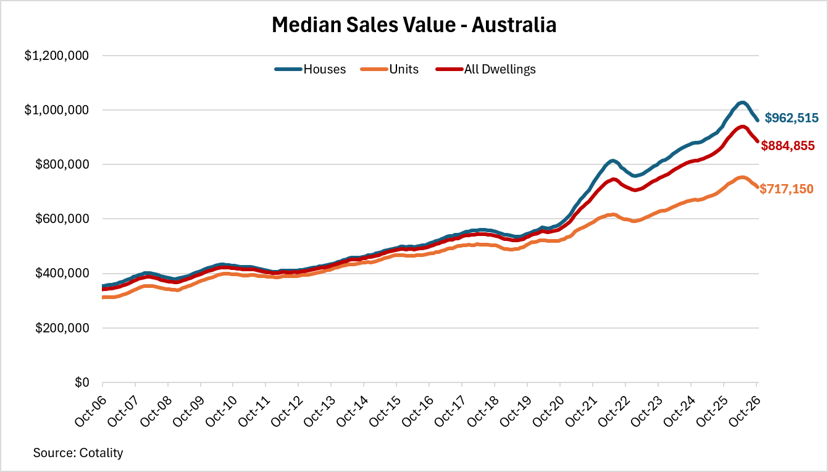
According to Cotality, national home values fell 1.2% in October and are now 6.7% below their March peak. That doesn’t mean every home has fallen by the same amount. What’s happening in your suburb may look quite different from the national picture.
Fewer properties are changing hands too. Cotality estimates there were 39,266 residential sales across Australia in October. That was 29.3% fewer than in October last year and 14.9% below the average for October over the previous 10 years. These are modelled estimates and can be revised.
Sales numbers matter because they tell us how many people are actually making a move. When fewer homes sell, the impact reaches beyond buyers, sellers and agents. Conveyancers, removalists, tradespeople and local businesses are all part of the process when a home changes hands.
Across the LJ Hooker network, our agents are seeing buyers take longer to make decisions, ask more questions and look closely at their budgets. Some sellers are also choosing to wait.
The market hasn’t stopped. People are still buying and selling, but activity is below average and transactions are taking more time.
It's not just interest rates
Higher repayments are only one part of the decision. Groceries, insurance, utilities and other everyday costs are also taking up more of the household budget.
There is uncertainty around the global economy too. The conflict in the Middle East and its effect on fuel and energy prices are adding to concerns about inflation and what happens next with interest rates.
Investors are also thinking about the changes to negative gearing and capital gains tax, which generally begin from July 2027. The rules will affect people differently depending on when they bought and the type of property they own.
The changes are intended to encourage more investment in new housing. In the meantime, some investors are reassessing the costs and returns of buying property, particularly established homes.
It’s difficult to separate exactly how much each factor is contributing to the slowdown. What matters is that households and investors are weighing up several pressures at once, not just the latest RBA decision.
More homes for sale doesn't mean more are coming onto the market
The listings figures show how a slower market can change the choices available to buyers.
In the four weeks to 25 October, new listings nationally were 12.5% lower than a year earlier. Yet the total number of properties advertised was 17.9% higher.
That might sound odd, but it’s fairly straightforward. Fewer homes are coming onto the market, while properties already listed are taking longer to sell.
It’s also worth putting the increase in perspective. Total listings were higher than a year ago, but only 3.1% above the comparable five-year seasonal average. Buyers have more choice than last spring, but the national figures don’t show a rush of new sellers.
For sellers, the competition includes properties that have been available for some time, not just the new listing down the road.
What does this mean for buyers and sellers?
For buyers with finance in place, a softer market can provide more time to compare properties and negotiate. In some areas, lower prices may create opportunities.
But a price fall on its own doesn’t make a property good value. The condition of the home, recent comparable sales and ongoing costs still need to stack up.
For sellers, understanding the competition and getting the price right from the start matters. Buyers have more choice in many areas and are generally less willing to stretch beyond their budget.
For someone looking to upgrade, it’s worth considering the whole move. A lower sale price on their current home may be offset by a lower purchase price on the next one, depending on the properties and markets involved. Transaction costs and any additional borrowing need to be considered as well.
What about renters and new housing?
Higher interest rates can increase costs for property investors, particularly those with mortgages. But higher costs for a landlord don’t automatically mean rents will rise.
Rents depend on the number of properties available, demand from renters and what households can afford to pay. Those conditions vary between locations and property types.
There is also a longer-term question about new housing. When it costs more to build and borrow, but buyers are less willing or able to pay, some new housing projects become harder to make work. That can mean homes are delayed or not built at all.
The ABS recorded around 47,200 dwelling completions in the June quarter. That was an improvement on the previous quarter, but below the average pace of 60,000 homes a quarter implied by the national five-year housing target.
Limited new supply can support the market over the longer term. But it doesn’t remove the immediate pressure on prices and sales when borrowing capacity and confidence are weaker.
What happens next?
It’s natural to ask when prices might reach the bottom. But prices stabilising and sales activity recovering are two different things.
Prices could stop falling before more buyers and sellers return to the market. Our analysis of Australian sales volumes shows that activity has been through substantial downturns before, but each cycle has been different. History can provide context, not an exact date for a recovery.
For the market to pick up, people need to feel more comfortable about making a move. That means having a clearer idea of what their repayments will be, what their current home might sell for and what they can afford to buy next.
That confidence won’t return everywhere at once. But when it does, we should start to see more buyers and sellers willing to make a decision.
DISCLAIMER - The information provided is for guidance and informational purposes only and does not replace independent business, legal and financial advice which we strongly recommend. Whilst the information is considered true and correct at the date of publication, changes in circumstances after the time of publication may impact the accuracy of the information provided. LJ Hooker will not accept responsibility or liability for any reliance on the blog information, including but not limited to, the accuracy, currency or completeness of any information or links.
Share