Buyers have more choice, even though fewer homes are coming to market
Australia’s residential property market has softened. Prices are falling, buyer demand has eased, and homes are taking longer to sell, but the increase in advertised stock is not being driven by a national surge in new listings, according to LJ Hooker.
An analysis of the latest data from Cotality shows fewer properties are being newly advertised, while sales have slowed enough for total listings to build. LJ Hooker Head of Research, Mathew Tiller, said that, for sellers, the competition is not just the new campaigns launching this weekend – it is also the properties buyers have already been considering.
New listings are below their usual spring levels
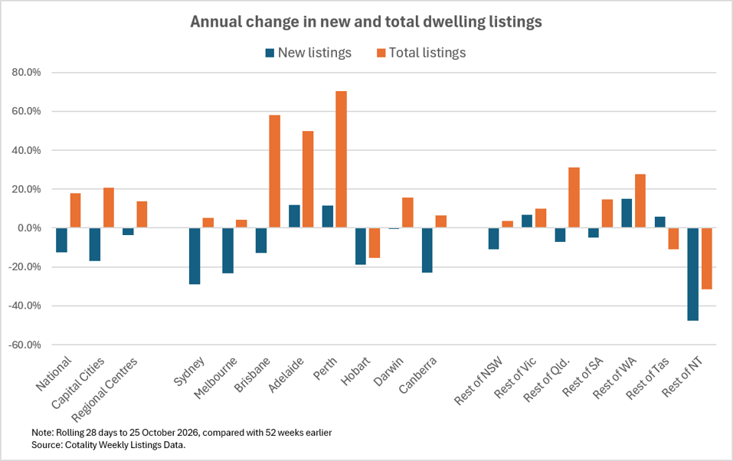
In the rolling 28 days ending 25 October 2026, 38,514 dwellings were newly listed nationally. That was 12.5% below the equivalent observation a year earlier and 13.4% below the average of comparable late October observations over the previous five years.
New listings have picked up through spring, but the flow remains below what we have typically seen at this time of year.
Total listings tell a different story. There were 150,786 dwellings advertised during the latest 28-day window, up 17.9% from a year earlier. However, that was only 3.1% above the five-year seasonal average.
Slower sales are allowing stock to build
Cotality’s latest sales data helps explain what is happening. An estimated 39,266 homes sold nationally in October, 29.3% fewer than in October 2025. Over the three months to October, estimated sales were 23.3% lower than in the same period a year earlier. In September, median selling time across the capital cities had increased from 23 to 39 days.
Cotality has attributed the build-up in advertised supply to sales slowing faster than the flow of new listings. National dwelling values also fell 1.1% in September, leaving them 5.2% below their March peak.
“The market is clearly weaker, but that does not mean more owners are rushing to sell,” Mr Tiller said.
“Fewer new properties are entering the market nationally, and the homes being advertised are taking longer to find buyers. Some owners with flexibility may choose to wait rather than accept a price below their expectations. Others may be uncertain about their next purchase and reluctant to commit to a move.
“The listings data cannot tell us how many owners are making those decisions or why. Waiting also does not guarantee a better price later, and holding costs continue in the meantime. What we can say is that the flow of fresh listings remains subdued, despite softer selling conditions.”
The national picture does not apply everywhere
Sydney and Melbourne recorded large annual falls in new listings, down 28.9% and 23.1%, respectively. Total listings increased by a more modest 5.2% in Sydney and 4.3% in Melbourne.
Brisbane’s figures show a much wider gap. New listings fell 12.9%, while total listings increased by 58.1%. Buyers are seeing considerably more advertised property than a year ago, despite fewer new listings entering the market.
Perth and Adelaide recorded increases in both measures, so their supply picture is different again.
While Perth’s total listings were 70.2% higher year-on-year, there were just 5.7% above the five-year seasonal average. That is a large annual increase, but a much smaller departure from recent seasonal conditions.
“For buyers and sellers, the useful question is how much comparable property is available in their own market and how quickly it is selling,” Mr Tiller said.
“A national percentage cannot tell an owner how much competition their particular property will face.”
More choice creates opportunities, but not every property is a bargain
For buyers who are ready and able to act, slower turnover can provide more time to compare properties and negotiate. There may be less pressure to make an immediate decision, particularly where several similar homes are available.
That does not mean every seller will accept a substantial discount or that every advertised property represents good value. Recent comparable sales and the alternatives available still need to guide the decision.
“For sellers, fewer fresh listings do not necessarily mean an easier sale - buyers can choose from the full pool of advertised properties, not just the latest campaigns,” Mr Tiller said.
“Pricing needs to reflect those alternatives and what buyers are currently prepared to pay.
For our network, the focus remains on using local evidence to set expectations. Competing listings, recent sales, selling times and vendor discounting provide a more practical basis for those conversations than national listing growth alone.”
What happens next depends on sales, not just listings
Subdued new listings could help limit further stock growth, but they will not necessarily prevent further price falls.
If sales improve relative to the flow of fresh listings, advertised stock could begin to ease. If demand remains weak, properties may continue to accumulate, and sellers may need to adjust their expectations to secure a sale.
“That makes sales volumes, selling times and vendor discounting important measures to watch alongside listings,” Mr Tiller said.
“Falling advertised stock alone would not establish that demand is recovering, as owners withdrawing properties can also reduce the total.
“The market does not need a surge in new listings for sellers to face tougher competition. It only needs buyers to keep purchasing more slowly than properties become available. Whether that gap starts to close will tell us more about the next phase of the market than the number of new listings alone.”
Share